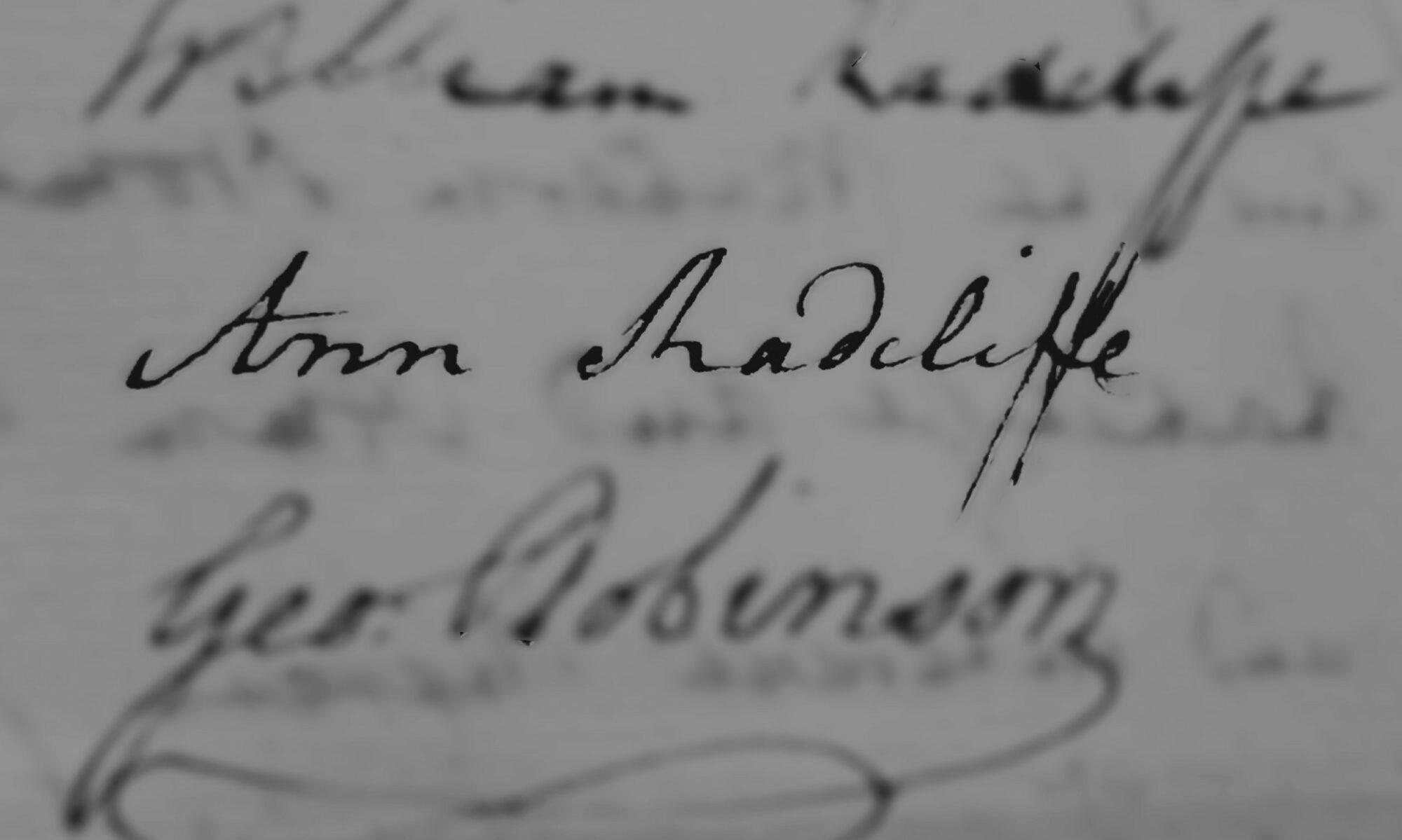
When I first started researching Ann Radcliffe, it was my job to go through hundreds and hundreds of listings in online databases to find any and all mentions of Radcliffe in the press. While at moments painstaking, this work was a real pleasure because the majority of what I found was fascinating, and that’s because Radcliffe was a fascinating writer. In addition to the many reviews of her work, Radcliffe appears frequently in reviews of the works of other writers, often used as a benchmark by which to measure their skill. She is referenced in non-fiction travel accounts where her name is used as a byword for a particular form of landscape description. She features in short stories, is the subject of poetry, and appears in a spate of articles, published between 1818-1821, that accuse Lord Byron of plagiarism. She is the subject of multiple obituaries, some of which appeared well before her death in 1823. Her poems are published readily, as are reviews of the theatrical adaptations of her novels. I found plenty of articles that reference her work in relation to the insidiousness of the modern novel, and many others in which she is repeatedly praised for her original genius and ability to terrify her readers. I read numerous articles that attested to the surge in popularity of what one reviewer termed ‘hobgobliana’, better known today as Gothic literature.1 And, beyond Nathan Drake’s 1798 assertion that Radcliffe was the ‘Shakespeare of Romance Writers’, I found other articles that compared her, favourably, to the bard.2
One of the main things that struck me as I carried out this research was the potency of Radcliffe’s reputation. A peerless trailblazer of the Gothic Romance, when it came to terrifying set pieces, nobody did it better. In 1823, a writer for The Quarterly Review challenged any reader, certain of their imperviousness to frightening fiction, to read
Mrs. Radcliffe’s Mysteries of Udolpho, alone, at one o’clock in the morning, and by a rushlight, just to convince themselves that the imagination may be worked upon by unreal terrors.3
Radcliffe’s ability to terrify her readers was widely documented in the press. Her masterful skill encouraged more than one critic to compare her to Shakespeare, with a 1819 retrospective on The Italian going so far as to declare her, in some ways, his superior:
She is the greatest sorceress in the terrific that has ever appeared: the murder scene in Macbeth “melts into thin air,” when compared to the black and lowering horrors of the attempted assassination in the Italian.4
Incredible praise like this helped to solidify Radcliffe’s reputation as head of the Gothic school of literature. But she was praised for more than just her ability to conjure terrifying scenes. Unlike her contemporary, Matthew Lewis, author of lurid Gothic tale, The Monk, Radcliffe was an expert in balancing terrifying twists and turns with scenes of a softer nature. As one reviewer put it,
The works of this writer lead us for ever to the tomb; but the wand which she bore was gifted only to call up the milder and unalarming spirits: we listen to her charms as we would to the incantations of a benevolent enchanter, whose “quaint apparitions” may soften and solemnize, but neither terrify nor hurt us.5
Radcliffe’s ability to strike fear into the hearts of her readers is undermined and dismissed somewhat in this critique. Her writing is softened and feminised, the potency of her terror diluted. But it is possible that estimations like this may have been key to her success. They demonstrate Radcliffe’s ability to thrive in the public eye as both the ‘greatest sorceress in the terrific’ and the ‘Shakespeare of Romance Writers’, her scenes
truly terrific in their conception, yet so softened down, and the mind so much relieved, by the intermixture of beautiful description, or pathetic incident, that the impression of the whole never becomes too strong, never degenerates into horror, but pleasurable emotion is ever the predominating result.6
Radcliffe conjured scenes of terror that rivalled Shakespeare’s, but the similarities between the writers doesn’t end there. They also seem to share a knack for writing provocatively while avoiding censure. Shakespeare famously avoided punishment by the censors; many of his contemporaries weren’t so lucky, with some even facing legal ramifications for publishing unsavoury material. Radcliffe, shrewd in her ability to temper terror and disguise anything in her novels that might be interpreted as a challenge to the status quo, avoided being castigated by the contemporary press as just another writer of tawdry ‘hobgobliana’, the fate that befell so many of her fellows. Like Shakespeare, Radcliffe expertly balanced a careful line: her extraordinary skill provided her with both success and protection from the press, allowing her to cultivate and uphold her peerless reputation as one of the greatest writers of her day.
Dr Rosie Whitcombe is an AHRC-funded Research and Innovation Associate for the Ann Radcliffe, Then and Now project. She has published on Radcliffe and Keats, and her essay, ‘Connection, Consolation, and the Power of Distance in the Letters of John Keats’, won the 2020 Keats-Shelley Essay Prize. She is currently working on her first monograph, John Keats and the Letter. She is also one third of educational YouTube channel, Books ‘n’ Cats, where she disseminates literary research to a wide audience.
- ‘Astonishment!!! A Romance of a Century Ago’, Anti-Jacobin Review and Magazine, or, Monthly Political, and Literary Censor, 16 (September 1803), 93. ↩︎
- ‘Observations on Objects of Terror’, The Edinburgh Magazine, or Literary Miscellany, (March 1799), 193. ↩︎
- ‘Art. VIII.—Private Correspondence of William Cowper, Esq.’, The Quarterly Review, 30 (October 1823) 13. ↩︎
- ‘Estimate of the Literary Character of Mrs. Ann Ratcliffe [sic]’, Monthly Magazine, or, British Register, 47 (March 1819), 125.
↩︎ - ‘Art. II.—Harrington and Ormond, Tales’, The British Review, and London Critical Journal, 11 (February 1818), 49. ↩︎
- ‘Observations on Objects of Terror’, The Edinburgh Magazine, or Literary Miscellany, (March 1799), 193. ↩︎